![Regrow_logo-1.png]](https://help.regrow.ag/hs-fs/hubfs/03.%20Logos/Regrow_logo-1.png?height=40&name=Regrow_logo-1.png)
Tillage Detection
Regrow’s tillage detection algorithms provide a field-level assessment of the impact of tillage activity at key agronomic points of crop and field management cycles. Fields are observed and analyzed for tillage impact in the time period prior to the planting of a commodity crop, as well as the period after the harvest.
Tillage Algorithm Methodology
Fields are monitored for tillage activity at key agronomic periods: the time period before a commodity crop is planted, and after the time period following the harvest. This results in two distinct tillage practice determinations for each commodity crop cultivation cycle.
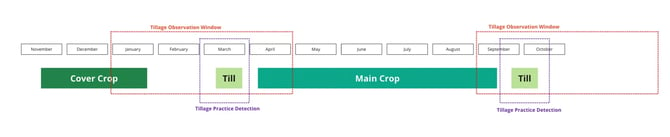
Satellite data can’t pinpoint the exact day a field is tilled, the equipment used, or soil disturbance depth due to the limited resolution (10-30 meters) and frequency (5-10 days) of satellite imagery. Cloud cover, especially in fall and winter, further restricts visibility.
Instead of tracking tillage directly, Regrow estimates residue cover using indices like the Normalized Difference Tillage Index (NDTI) and Crop Residue Cover Index (CRC). Residue cover acts as a proxy for soil disturbance. No till practices will leave high levels of residue cover on the field, while conventional tillage will leave minimal residue on the soil surface (see Tillage Intensity table below).
Weekly residue cover percentages are calculated over the two 8-week observation periods, pre-plant and post-harvest. Observations with the highest confidence (where the the greatest area of the field was observed and where residue cover estimations within the field were consistent) are identified, and a tillage intensity classification is made based on the median residue percent of those observations. This provides two tillage intensity estimations for each crop cycle.
Summarizing Tillage Intensity
There are various types of tillage methods and implements that result in wide gradients of tillage intensity and disturbance. The USDA has provided classifications that relate residue observed on fields to tillage intensity, providing guidance that can be applied across projects and regions. The classifications relate directly to reducing erosion and emission, maintaining or increasing soil health and organic matter, and increasing plant-available moisture.
Regrow uses the USDA residue thresholds as the basis for relating residue amount to a tillage practice. While these thresholds have shown to be a reliable proxy for relating residue amounts to tillage practice for crops in European countries, they have been found in North American to not be as reliable in corn-soy rotations. For example, crops that produce a large volume of biomass or biomass that persists (ex: corn) has a different residue signal compared to 'fragile' crops where the biomass breaks down quickly (ex: soybeans, cotton). As a result, Regrow uses two sets of residue thresholds in North America to determine tillage practice, depending on the fragility of the crop's residue.
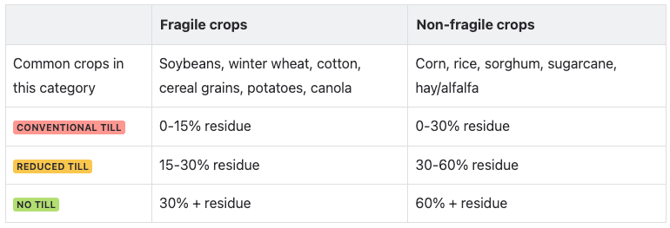
*Note: Non-fragile thresholds are applied in European countries to all crops.
The following table contains the full list of fragile vs. non-fragile crops. Please note that this list is inclusive of crops across all regions. Some crops may not be available in every region.
| Fragile crops | Non-fragile crops |
| asparagus, barley, beet, berry, blueberry, broccoli, cabbage, camelina, canary_seed, canola, canteloupe, carrot, cauliflower, celery, chickpea, clover, corn_silage, cotton, cranberry, cucumber, dry_bean, eggplant, grape, hop, legume, lentil, lettuce, melon, mustard, oat, onion, pea, peanut, pepper, potato, pumpkin, radish, rye, rye_spring, safflower, soybean, speltz, squash, strawberry, sugar_beet, sunflower, sweet_potato, tobacco, tomato, triticale, turnip, vetch, watermelon, wheat_durum, wheat_spring, wheat_winter | alfalfa, buckwheat, corn, flax, grass_annual, grass_perennial, hay, millet, miscanthus, other_hay, pasture, pop_or_orn_corn, rice, ryegrass, shrub, sod_grass, sorghum, sugarcane, sweet_corn, switchgrass |
Tillage Detection Confidence
Monitor provides a confidence score for each tillage intensity determination. The confidence score is dependent on the amount of the field observed and the variability of residue cover each week. Every weekly observation receives a confidence score from 1 to 3 (with 3 being highest confidence), which would mean a majority of the field was observed with low variability in residue cover estimates across the field (we estimate residue cover for every 10m x 10m pixel). The weeks with the highest confidence in the 8-week observation period (for example, all weeks with confidence score = 3) are used to make the determination, and that confidence score is provided.
Confidence values are reported on a scale of 0-3. Regrow recommends using tillage type predictions when model confidence is 3.
Accuracy and Validation
To assess the accuracy of both residue cover estimations and tillage classification we compare the estimates provided by Monitor to ground truth data provided at the field scale as well as to regional summary statistics of tillage practices where available. Accuracy in identifying conventional till is generally high, but the intricacies and gradients of residue cover that separate reduced till from conventional till can be more difficult to identify, especially as different crop types can have very different post-harvest residue even when the tillage practice is the same. Our most recent validation, using over 22,000 observations, demonstrated a 71% accuracy in identifying conventional tillage vs. conservation tillage (inclusive of no till and reduced till) in the United States (continental). We are working to provide greater specificity based on crop type and region to achieve higher accuracies in this realm.