![Regrow_logo-1.png]](https://help.regrow.ag/hs-fs/hubfs/03.%20Logos/Regrow_logo-1.png?height=40&name=Regrow_logo-1.png)
Cover Crop Detection
Monitor’s Green Cover algorithm predicts the presence or absence of a cover crop during the agronomic periods of time when cover crop activity can happen (between harvest and planting of two commodity crops).
When are fields evaluated for a Cover Crop?
Fields are evaluated for cover crops after the harvest of one commodity to the planting of the next commodity crop. We refer to this time period as an 'observation window'. Because the harvest and planting dates are variable per field, the cover crop observation window is dynamic to each cultivation cycle.

Fields are monitored during the observation for emergence, persistence and vigor of green cover. To avoid inclusion of temporary regrowth, weeds, volunteers and other non-intentional green signals in cover crop determinations, cover crop observations are only made if there are at least 8 weeks between two the commodity crops. We also account for temporary regrowth, weeds and volunteers through regional parameters that reflect the level of growth in surrounding natural herbaceous vegetation.
Methodology
Cover crops are detected using NDVI, an index that is responsive to chlorophyll in the vegetation and serves as a proxy for photosynthetic potential. In other words, we can use this index to monitor how 'green' a field is at a given time, as well as over a time period. Satellite images, captured every 5-10 days, measure the strength of green cover emergence, the persistence of the cover crop over time, and the greenness relationship of the field to the surrounding area throughout the observation period.
Monthly NDVI is calculated and used to assess the persistence and vigor of green vegetation over time. The mean NDVI of the field over the cover crop observation window is compared to regional NDVI thresholds to measure the quality and extent of cover crops on a field. Fields with higher NDVI values indicate the presence of healthy, sustained vegetation, which is often a sign of intentional cover cropping practices.
Cover Crop Classifications
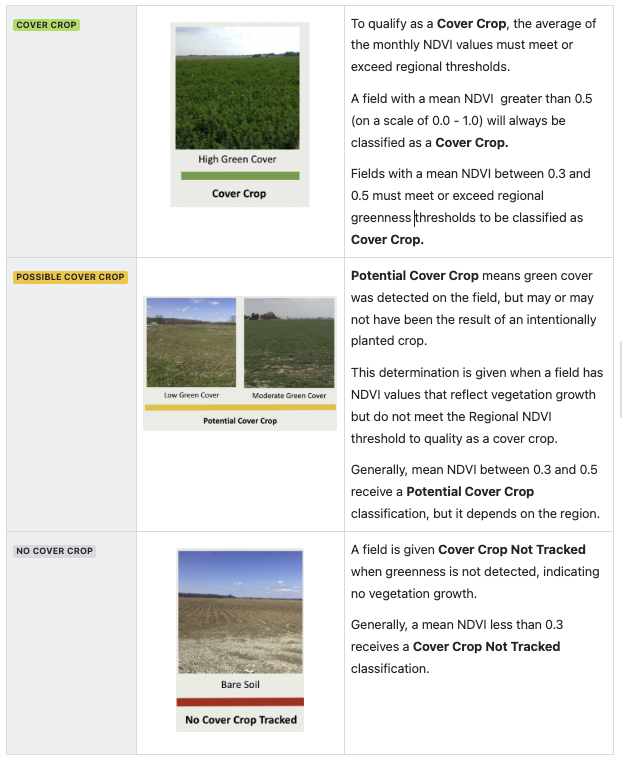
Cover crop classifications are based on the level of greenness sustained throughout the non-commodity crop period.
Regional NDVI thresholds are calculated annually using surrounding natural herbaceous vegetation to quantify constraints on growth due to local and inter-annual variation in weather.
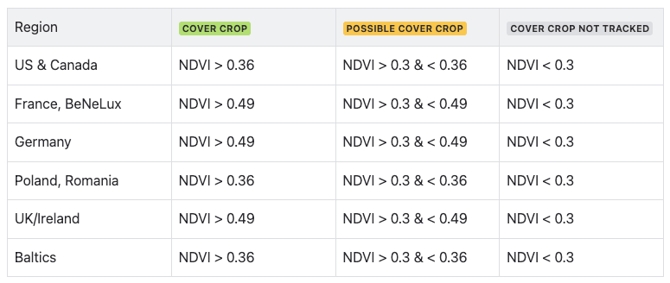
Classifications are region-specific. We calculate inter-annual regional thresholds based on the NDVI of surrounding natural herbaceous vegetation to determine whether the extent and strength of green cover on a field corresponds with cover crop activity. Below are examples of thresholds for a given year across a range of regions. In some cases winter extremes can severely limit regional growth, lowering the threshold to its minimum.
Cover Crop Confidence
Confidence in the cover crop determination is based on the extent of the field observed throughout the non-commodity crop period. For each month we calculate the percent of the field observed. The average of the monthly percent observed values is used to determine the confidence.
Confidence values are reported on a scale of 0-3.
Emergence Quality and Emergence Quality Confidence
Emergence quality is a measure of how strongly a cover crop emergences after planting. This metric along with the mean NDVI provide additional insights about how a cover crop developed, and by extension the resulting cover crop classifications. Emergence quality is calculated using the first three months of the cover crop observation period, where Monitor returns a No vegetation, Weak emergence, Good emergence, or Strong emergence based on the highest NDVI value observed across the first three months. Emergence quality confidence metrics indicate the percent of the field observed during the month with the highest NDVI.
These data points provide additional context on cover crop outcomes. Winter kill and non-sustained emergence are often observed on intended cover crops (those where a field is intentionally seeded, but the cover crop failed to thrive) - in these cases the field can receive a Potential Cover Crop or Cover Crop Not Tracked classification as the average NDVI over the full observation period may be quite low. These updated metrics can indicate that initial vegetation growth was present or strong, but succumbed to adverse conditions (freezing temperatures, snow/ice, etc.) - highlighting cases when a farmer reports planting a Cover Crop, but Monitor does not return that classification.
Accuracy + Validation
Cover crop practice designations made by Monitor are compared to ground truth data provided by farmers and agronomists, and to regional summary statistics provided by government agencies (e.g. USDA) or farmer cooperatives. When compared Monitor Cover Crop results to over 25,000 field observations, Monitor displayed an overall accuracy of 85% in the United States (continental). When compared to the USDA Ag Census, Monitor cover crop results were within +/- 20% of the state level reported cover crop planting rates for 90% of states in the 2017 census and 81% of states for the 2022 census.