![Regrow_logo-1.png]](https://help.regrow.ag/hs-fs/hubfs/03.%20Logos/Regrow_logo-1.png?height=40&name=Regrow_logo-1.png)
Inputs
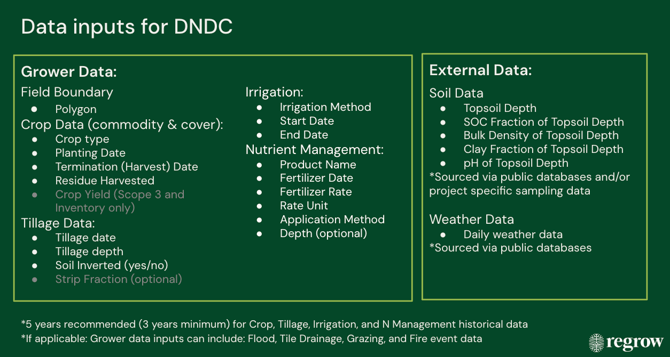
The API requires detailed management data inputs for both baseline and intervention events. Including: crops grown, field events (like tillage), soil measurements, and weather data which are automatically included in the API.
Quantification
Outcomes = Counterfactual period - Intervention/practice change period
The field history is used to initiate the DNDC model with field level management practices as well as to construct the counterfactual.
The Intervention/Practice change period corresponds to time after the regenerative practice change has happened.
The outcomes reflect the difference between what would have happened (counter factual) and what happened (intervention/practice change).

Uncertainty in our quantification
Quantifying model uncertainty is critical for transparent use in ecosystem markets, supply shed and ESG reporting.
Quantifying uncertainty requires the use of independent validation data. The basic approach includes statistical analysis of the residuals of modeled versus measured estimates of greenhouse gas emission.
We discount model estimates of GHG reductions to account for this uncertainty. We calculate an appropriate deduction based on an acceptable confidence interval. This interval is flexible for both Scope 1 & 3 assets. The structural uncertainty deduction applies to the aggregate at project scale, since the deduction factor depends on the number of fields and simulations included.
Outcomes highlights
Crop/Program Level Outcomes: Aggregated outcomes at crop (/project) level for reporting purposes and credit generation.
Field Level Outcomes: Field level outcomes for reporting purposes and farmer incentives.
Outcome general structure:
- Reversible credits
- dSoc
- Non-reversible credits
- Direct N2O
- Indirect N2O
- Soil CH4
Global warming potential
Today intervention outcomes use AR5 when converting outcomes to CO2 equivalents.