![Regrow_logo-1.png]](https://help.regrow.ag/hs-fs/hubfs/03.%20Logos/Regrow_logo-1.png?height=40&name=Regrow_logo-1.png)
The DNDC model
What is DNDC, and why does Regrow use it for rice?
DNDC (DeNitrification-DeComposition) is a process-based biogeochemical model that simulates carbon and nitrogen cycling in agricultural soils. It is Regrow’s core quantification engine for GHG outcomes and runs as a Tier 3 methodology — the highest IPCC tier. For rice, DNDC models the anaerobic soil conditions created by flooding that drive methane (CH₄) emissions, making it particularly suited to paddy rice systems where water management is the primary intervention.
How does rice differ from upland crops in the model?
Rice under continuous or periodic flooding is an anaerobic system, so CH₄ becomes the dominant emission pathway rather than N₂O (which dominates upland crops). DNDC handles this through a dedicated flooded-soil sub-model. The practical implication: flood timing is your most critical input (replacing tillage and crop rotation importance in upland systems), and CH₄ is the output you will care most about.
Data Inputs for Rice
What is the single most important input to get right?
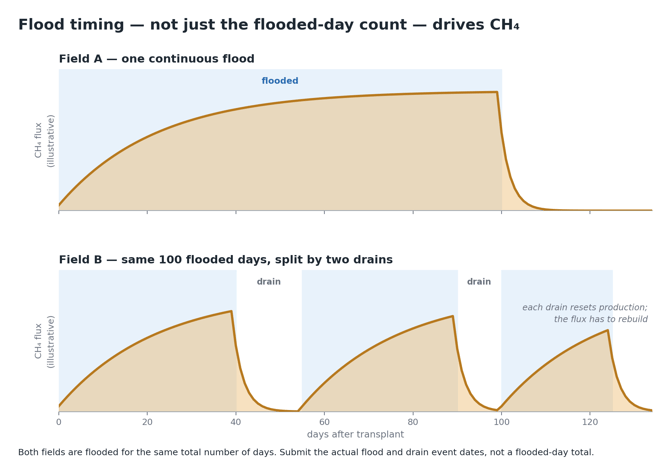
Flood event dates — specifically the start and end of your AWD (Alternate Wetting and Drying) flood cycles. These dates drive the methane (CH₄) outcome more than any other input. Drainage timing matters more than flooding start; 1–2 days of imprecision on the flood end date is acceptable, but larger errors significantly affect model outputs.
What exactly does "flood end date" mean?
The flood end date is the day you cut off water to the field — i.e., when the drainage event begins. It is not the date the field has fully dried. Precision within 1–2 days is fine; do not guess dates that are weeks off.
What drives CH₄ in a rice system?
Three levers dominate, and two of them are yours to submit:
- Soil clay content — a field property; lower clay generally gives higher CH₄.
- Flooding — not just how many flooded days, but when they fall. Two fields with the same flooded-day count can differ materially if the flood periods sit differently relative to the crop.
- Residue — crop residue returned to the field is the substrate that feeds methane production, so residue management, and residue carried into the reporting period, moves CH₄ directly.
Weather, soil carbon and fertilizer matter too, but these three are where the data you submit most changes the answer.
Is soil sampling required to use the Rice API?
No. When no on-site soil data is available, Regrow uses SoilGrids — a global soil database with 250 m resolution — as the default. SoilGrids provides less precision than lab-sampled data but is acceptable when no carbon crediting protocol specifically requires on-site sampling. If your protocol eventually mandates soil data, that requirement comes from the protocol, not from Regrow.
Why does N₂O change when I am only changing water management?
AWD changes the soil's aerobic-to-anaerobic balance through periodic drainage. That affects both CH₄ (less time in flooded, anaerobic conditions) and N₂O (through changes in nitrification and denitrification). A water-management change therefore moves both gases, and the API reports both.
Nutrient inputs are a required model input: submit the nutrient management the growers actually applied, as reported.
How many years of historical data does DNDC need to spin up?
DNDC requires approximately three years of historical management data to initialize the soil carbon pools before producing stable GHG outcomes. For rice, this is simpler than for upland crops because the growing system is more uniform (same crop, similar rotation). Farmers with identical historical practices can share a single spin-up record.
Is water table depth currently an input to the model?
Not as of early 2026. The ability to ingest actual water table depth measurements for more granular AWD modeling is on the roadmap and targeted for Q3 2026, pending a new DNDC version release. This feature would allow farmers with water table monitoring to provide more precise flood depth data rather than relying on inferred flooding from date ranges alone.
What emission gases does the API report for rice?
The Measure API reports both CH₄ (methane) and N₂O (nitrous oxide, direct and indirect) at the field level. These are returned as separate line items so you can see the contribution of each gas. For rice AWD programs, CH₄ is typically the dominant source of reductions.
How does the Measure API handle straw burning in rice systems?
Straw burning in rice systems is recorded using the fire event in the Measure API.
Fire events affect modeled outcomes because burned residue is not returned to the soil. This matters for three GHG components:
- SOC — organic matter input to the soil is reduced
- N₂O — nitrogen that would have decomposed in the soil is lost through combustion instead
- CH₄ — for rice specifically, residue inputs influence the anaerobic conditions that drive methane production, so removing that input affects CH₄ flux
What about the CO₂ from the fire itself? DNDC does model CO₂ emitted from combustion events, but those values are not carried into the Measure API and are never included in the CO₂eq outcomes that Regrow reports. The practical effect in the model is similar to a residue-removal event: biomass is removed from the system with nothing added back — ash is not accounted for.
Submissions
How do I set the reporting period for rice, and how are the wet and dry seasons handled?
Rice programs typically run two growing seasons a year — a dry season and a wet season. How you set the reporting period depends on what you are reporting, and there is some flexibility in how the period is defined:
- Scope 3 — Seasonal submission (two outcome reports per year) tie the reporting period to the crop harvest period; for double-cropped rice it thus follows each harvest rather than a roughly annualized basis. Each season is submitted separately as its own cultivation cycle and likewise reporting period, producing two outcomes per year — one for the dry season and one for the wet season. The historical baseline must match this structure: two cultivation cycles per year, each covering approximately six months and containing only one growing season. This produces two outcome reports per field per year.
- Scope 1 — Annual submission (one outcome report per year) The reporting period covers the full calendar year. You submit one cultivation cycle per field per year, containing all management events from both growing seasons in chronological order. Historical baseline data follows the same structure — one cultivation cycle per year spanning both the dry and wet seasons consecutively. This produces a single outcome report per field per year.
Whichever you use, your history must be structured the same way as the intervention data.
What does my historical data actually do?
Your history does three jobs at once: it establishes eligibility, it sets DNDC's initial soil conditions, and — with a generated baseline method — it becomes the counterfactual itself. The historical management events are played forward into the reporting period, with their dates extrapolated onto the intervention year's growing season. Under climate_matched_rice, rice planting and harvest dates are copied from the intervention year and the other events are played forward from history.
So the counterfactual you are credited against is your own history, transposed. Errors in the history carry straight into the baseline rather than being washed out by an independently built counterfactual. The exception is custom, where you supply the counterfactual yourself.
How does the climate_matched_rice baseline work?
It keeps the intervention year's rice crop and replays only your historical water and fertilizer management onto it. The baseline and intervention then run on the same season and weather, and differ only in the practices you changed.
- One thread per historical rice season. Every cultivation cycle in the field's history that grew rice becomes its own baseline thread.
- Crop copied from the intervention year. Rice planting and harvest dates come from the intervention year, not from history.
- Flood and fertilizer replayed proportionally. Each historical flood start, flood end and fertilizer application date is moved to the same relative point in the intervention season, measured as a share of the days between planting and harvest. Fertilizer types and amounts are replayed unchanged. Tillage and burning dates are shifted the same way.
- Threads averaged. DNDC simulates each thread, and the results are averaged into the baseline outcome.
Worked example: in a 150-day historical season, the flood started 5 days after planting (3.3% in) and ended on day 144 (96% in). With a 180-day intervention season, the counterfactual flood runs from day 6 to day 173. Multiple historical floods (AWD in the history) are each moved the same way.
Two checks reject a field before it runs: the intervention year must be rice, and rice must appear at least once in the field's history. The method also assumes a single rice crop in the intervention year. The method is built for water-management changes such as AWD. It does not fit interventions that change the crop calendar itself, such as delayed flooding or a switch in seeding method. SOC removals are not reported under this method.
Watch out — blended in a rice rotation.
A blended baseline builds a counterfactual thread for each crop phase in the field's history and then averages them. In a rice–soy rotation that averages a high-methane rice year against a near-zero-methane soy year, which can pull the counterfactual below the intervention and produce a negative result.
Worked example: rice baseline 180 kg CH₄/acre and soy baseline 0 average to 90; an intervention at 100 then gives a delta of −10 kg CH₄/acre. Worth weighing before choosing blended for rotated rice.
Defintions
|
Term |
Definition |
|---|---|
|
AWD |
Alternate Wetting and Drying — a water management practice where rice fields are periodically drained and re-flooded, reducing anaerobic conditions and methane emissions relative to continuous flooding. |
|
CH₄ |
Methane. The dominant GHG emission from flooded rice paddies. Reduced by AWD. |
|
Climate-matched baseline |
A counterfactual baseline constructed by matching intervention fields to reference fields with similar climate, soil, and historical management. Used instead of a project-specific historical average to control for natural variability. |
|
DNDC |
DeNitrification-DeComposition. Regrow’s Tier 3 process-based biogeochemical model. Simulates C and N cycling in soils, including methane from flooded rice systems. |
|
IS-TEST |
A flag in the API request (true/false). When true, no billing is incurred and outcomes returned are fake. Use for integration testing only. |
|
N₂O |
Nitrous oxide. A potent GHG emitted from soil nitrogen cycling. Reported alongside CH₄ in rice API outputs. |
|
PDD |
Project Design Document. The ex-ante document submitted to a carbon standard (e.g., Verra, Gold Standard) describing the project design and estimated GHG outcomes. |
|
SoilGrids |
A global soil database (250 m resolution) used by Regrow as the default soil data source when no on-site sampling is available. |
|
VM0042 |
Verra’s methodology for agricultural land management, currently used with a climate-matched baseline for rice programs. |
|
VM0051 |
Verra’s methodology specifically for rice cultivation. Planned for inclusion in Regrow’s supported protocol list in 2026. |